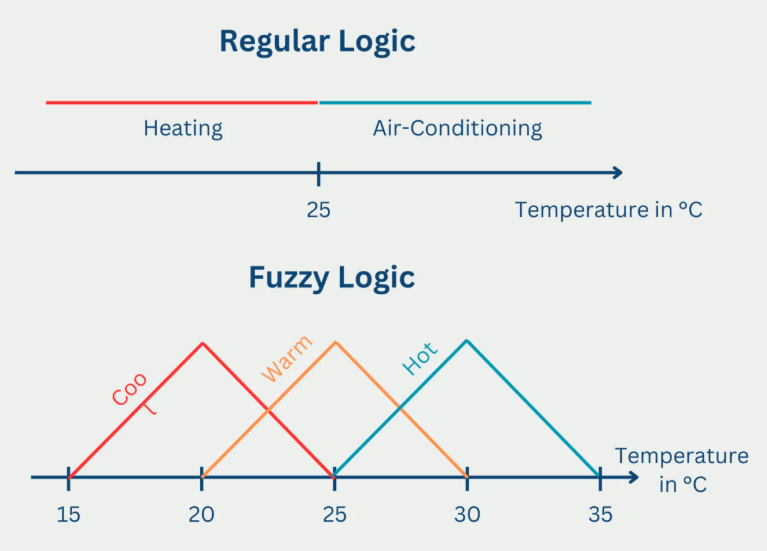
A logic that represents an ambiguous feature more accurately
=> Mathematically implement ambiguous representation of human language (Ex: little bit, very, quite, definitely)
Ex) representing age as old / young -> classifying with a single age threshold does not correspond with human's cognitive classification standard: if we set age 70 as a threshold, is age 69 young?
-> we must set/assume distribution of feature values continuously even in classification problem
-> age 69 has 0.6 of 'old' featureand 0.2 of 'young' feature
1. Terminology and prior concepts
universe of discourse: interval of feature value that each datapoint can have (Ex: age - 0~100)
degrees of membership: the degree of how much likely each datapoint belong to individual class (Ex: old-0.6, young-0.2)
(0<=m<=1)
membership function: function that calculate degrees of membership in each datapoint (Ex: f(age) -> 0.6, 0.2)
-> use domain knowledge or NN or fuzzy system or neuro-fuzzy system to model membership function!
* Way to represent degrees of membership
State: continuous var (age) -> discrete var (old, middle, young)
Model membership function for each discrete var -> old~f(age), middle~f(age), young~f(age)
Ex) old={60: 0.2, 61: 0.25, ..., 70: 0.4, 71: 0.5,... 99: 1, 100:1}
middle ={21:0.15, 22:0.18, ..., 40:0.8, 41:0.84, ..., 61:0.2, 62:0.15,... }
young={15:1, 16:1, 17:1, ..., 33:0.1, 34:0.05}
-> three fuzzy sets
2. Logical calculation using basic fuzzy sets
(1) set operation: build new fuzzy set
- Union: each age value -> maximum degree of freedom within classes that the age belong to
Ex) age 61 belongs to both old group and middle group -> union set contains {61:0.25} component
- Intersection: each age value -> minimum degree of freedom within classes that the age belong to
Ex) age 61 belongs to both old group and middle group -> intersection set contains {61:0.2} component
- Complement: (1-degree of freedom) within classes that the age belong to
Ex) Complement set of old group -> {60:0.8, 61:0.75, ..., 70:0.6, 71:0.5, 99:0, 100:0}
(2) Hedge operation: numercially implement adverbial representation originated from natural language
Ex) hedges: little, very, quite, definitely => membership function = {mu(x)}^q
little -> q=3
very -> q=2
quite -> q=0.5
definitely -> 2{mu(x)}^2 (0<=mu<=0.5), 1-2{mu(x)-1}^2 (0.5<=mu<=1)
Comprehensively, these two operation help to numercially model more complex ambiguity of classification.
3. Clinical application of fuzzy logic
How can fuzzy logic be applied to clinical context?
Most medical statements are composed with ambiguous expressions -> Ex: Severe cancer pain indicates a poor prognosis. But fuzzy logic and fuzzy set can help converting natural language expression into numercial expression that computer algorithm can process
* Instead of directly using LLM model to process human language expression, we can use fuzzy logic + ML model to increase clinical explainability, accuracy
'머신러닝' 카테고리의 다른 글
| ensemble learning (0) | 2026.02.23 |
|---|---|
| Affine and Convex (0) | 2026.02.23 |
| Genetic Algorithm (0) | 2026.02.21 |
| kNN, k means clustering, a priori method (0) | 2026.02.21 |
| Linear methods for classification - LDA, QDA, RDA (0) | 2026.02.02 |